Updated July 2026
Two packaged foods can carry nearly identical Nutrition Facts panels — same calories, same fat, same sodium, even similar fiber — and turn out to be completely different foods the moment you read the ingredient list. That's the whole case for the ingredient list: it's where the real information lives.
Food companies are counting on you not to check. Most of us decide whether to buy a product in just a few seconds, often three to five, so the front of the package is engineered to win that glance while the truth sits quietly on the back.
Misleading food packaging is one of the things I'm very passionate about. I even spearheaded an effort within the American College of Cardiology to send a letter to the FDA — on behalf of an organization representing more than 52,000 clinicians — asking the agency, among other things, to end the practice of ingredient-list manipulation. Because even the most regulated part of the package is being gamed by food manufacturers.
Isn't the ingredient list the most trustworthy part of the label?
It should be — it's the most tightly regulated part of the package. FDA rules (21 CFR 101.4) dictate which ingredient names are allowed, the order they appear in, even the print size, and getting it wrong exposes a company to real fines. The rule that matters most to you: ingredients are listed in descending order by weight, so the first few tell you what a food mostly is. That's why "check the first five ingredients" is the single most useful habit in reading a food label.
Here's the catch: knowing that rule is exactly what lets you see how it gets bent. There are two main moves — splitting and combining.
What is ingredient splitting?
Splitting breaks one ingredient group — almost always added sugar — into several differently named versions, so no single one weighs enough to rank near the top. Here's the current label for Planters Honey Roasted Peanuts:
Peanuts, sugar, peanut oil, honey, corn syrup, sea salt, fructose, cornstarch, xanthan gum.
Count the sugars: sugar, honey, corn syrup, and fructose — four of them, all doing the same job. Why four names instead of one? Because combined into a single "sugar," that sweetener might have outweighed the peanuts and jumped to the front of the list. Split into four, it stays scattered quietly down the label, and the peanuts keep top billing.
What is ingredient combining?
Combining is the opposite move: bundling several items under one wholesome-sounding umbrella name so it floats to the top. The FDA lets a compound ingredient list its parts in parentheses — a rule meant for genuinely standard items like chocolate. Watch what Kashi GOLEAN Crunch does with it:
Kashi Seven Whole Grains and Sesame Blend (hard red wheat, brown rice, barley, triticale, oats, rye, buckwheat, sesame seeds), soy flakes, brown rice syrup, cane sugar, chicory root fiber, whole grain oats, expeller pressed canola oil, honey, salt, cinnamon…
"Seven Whole Grains and Sesame Blend" sounds wonderful sitting at number one. But it's an invented grouping, and bundling eight grains together guarantees they outweigh any single ingredient behind them. Break that blend back into its eight separate grains and each one shrinks — quite possibly to less than the brown rice syrup, cane sugar, or honey scattered below it. Those are three separate added sweeteners, in a cereal named for leanness that still carries about 13 grams of sugar per serving. The combining is what keeps you from seeing that at a glance.
How far does this go?
Far enough that a "strawberry protein" bar can contain repeated doses of added sugar and not a single strawberry. Look at the current label for Kellogg's Special K Strawberry Protein Meal Bar: added sugar shows up as sugar inside the "strawberry flavored cranberries," then again as sugar, fructose, and corn syrup further down. And the strawberries? There aren't any — the fruit pieces are strawberry-flavored cranberries. If you had to read that twice to catch it, that's the point. The complexity is the camouflage.
Which ingredients should make you put the package back?
A few reliable red flags, because each one signals a food that's been engineered rather than grown. Added sweeteners wearing their many aliases — corn syrup, high-fructose corn syrup, dehydrated cane juice, and dozens more. Isolated fibers added back in — inulin, chicory root fiber, soluble corn fiber — which tell you the base food had little of its own. And things that aren't food at all: carnauba wax, titanium dioxide, artificial colors and flavors.
The more of these you see, and the more of the list you don't recognize as actual food, the further that product sits from something you'd make in your own kitchen. The simplest rule still wins: a short list of recognizable ingredients beats a long list of chemistry.
None of this is accidental, and it's a real driver of why so many of us are sick despite trying to eat well. People make the choice they think is right and get quietly duped.
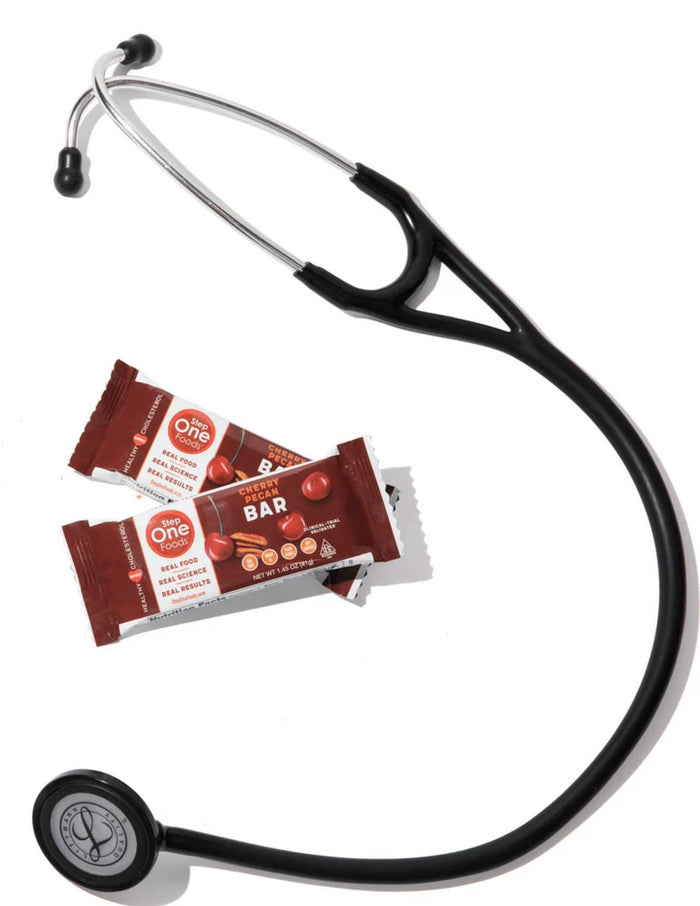
At Step One, we don't split or combine anything, because we don't have to. Every ingredient is there for a reason — to deliver clinically meaningful whole-food fiber, omega-3s, antioxidants, and plant sterols. Read our labels as closely as you like; there's nothing hiding.
If you're new to this site and found this useful, I write one of these evidence-based articles every week. You can get them in your inbox by joining my email list at the bottom of this page. No spam, no requirement to buy anything, just practical knowledge.


From Dr. KlodasFood, but with a
Try Step One Foods Today
Food, but with a
medical degree.
I built Step One Foods for my patients. Two servings a day replace the breakfast and snack you already eat.
Tested in a double-blind, randomized crossover trial conducted at Mayo Clinic and the University of Manitoba, 80% of participants lowered their LDL in 30 days.
Your first order is backed by our money-back guarantee.